The calendar has turned. So it feels like the right moment to ask a simple question:
How will HR look in 2026?
Not in theory. In real organizations. Across different countries.
This is not a trend list. It is my professional forecast shaped by projects, boardroom debates, conferences, and HR networks.
If HR fails in 2026, it would not be because of technology. It will be because of decisions.
For me, the space for safe HR closed in 2025. Here is why.
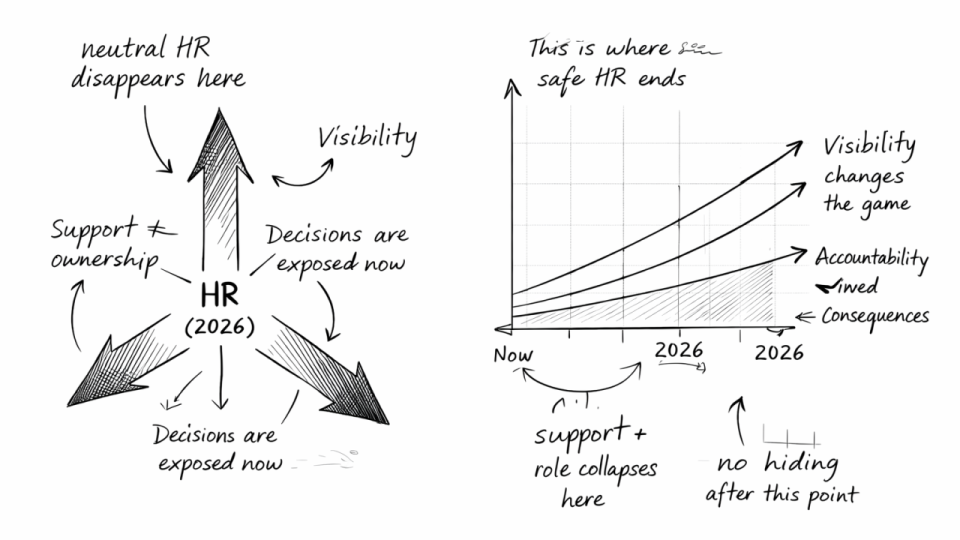
Across countries and HR ecosystems, the same shift is happening. Three forces are coming together and together they are changing the role of HR.
- Decision pressure. Cost. Productivity. Speed. Less time. Fewer resources. Tougher choices.
- Visibility. AI decisions leave traces. Pay is transparent. Data can be questioned and compared.
- Accountability. Regulation. Audits. And employees who expect explanations, not slogans.
When these three meet, neutral HR disappears. Supporting from the side is no longer enough. Avoiding decisions no longer protects anyone.
Everything below follows from this.
So here is how I see the key shifts shaping HR in 2026.

1. Work is being rewritten
AI is not replacing jobs. It is reshaping tasks inside jobs. What I see in organizations:
- responsibility moves, accountability doesn’t
- people are unsure where their role begins and ends
- mistakes happen in the gaps
Research from OECD – OCDE shows that algorithmic systems already assign tasks and evaluate performance, often without clear human oversight. When something goes wrong, responsibility is unclear (https://www.oecd.org/en/publications/algorithmic-management-in-the-workplace_287c13c4-en.html ).
The International Labour Organization shows that generative AI fragments work: some tasks disappear, some accelerate, others require stronger judgment. Jobs do not vanish, but they change shape (https://www.ilo.org/sites/default/files/2025-05/Research%20brief_FINAL_15May2025_21.05.25_1.pdf ).
Why this matters:
If HR does not redesign work deliberately, work will still change – just badly. In 2026, HR will be judged on one question: Who does what and who is accountable?
2. Skills decide everything
Everyone talks about skills. Few let skills decide. What I see instead:
- promotions still follow titles
- learning exists without movement
- pay ignores capability
The World Economic Forum shows that roles are changing faster than job structures. Skills are becoming the only stable reference point (https://www.weforum.org/reports/the-future-of-jobs-report-2025 ).
The OECD shows that when skills are invisible, inequality grows. Some move forward. Others get stuck (https://www.oecd.org/content/dam/oecd/en/publications/reports/2025/12/oecd-skills-outlook-2025_ac37c7d4/26163cd3-en.pdf ).
Why this matters:
By 2026, skills will no longer support decisions. They will be the decisions, for instance about hiring, pay, mobility and power.
3. The silent manager crisis
Change rarely fails at the top. It fails in the middle. Managers today must:
- run hybrid teams
- work with AI
- develop people
- deliver results
- protect wellbeing
The Eurofound shows that hybrid work succeeds or fails largely because of management quality, not policy. Poorly supported managers create stress, conflict and disengagement (https://www.eurofound.europa.eu/en/publications/all/hybrid-work-europe-concept-and-practice ).
The CIPD shows the same pattern again and again: expectations grow faster than support (https://www.cipd.org/globalassets/media/knowledge/knowledge-hub/reports/2025-pdfs/8868-good-work-index-2025-report-web1.pdf ).
Why this matters:
Managers are not weak. The system around them is. In 2026, HR will be judged by whether managers can function, and not by how many programs exist.
4. From “trust me” to “prove it”
Until recently, HR could say: Trust us. The system is fair. That era is over.
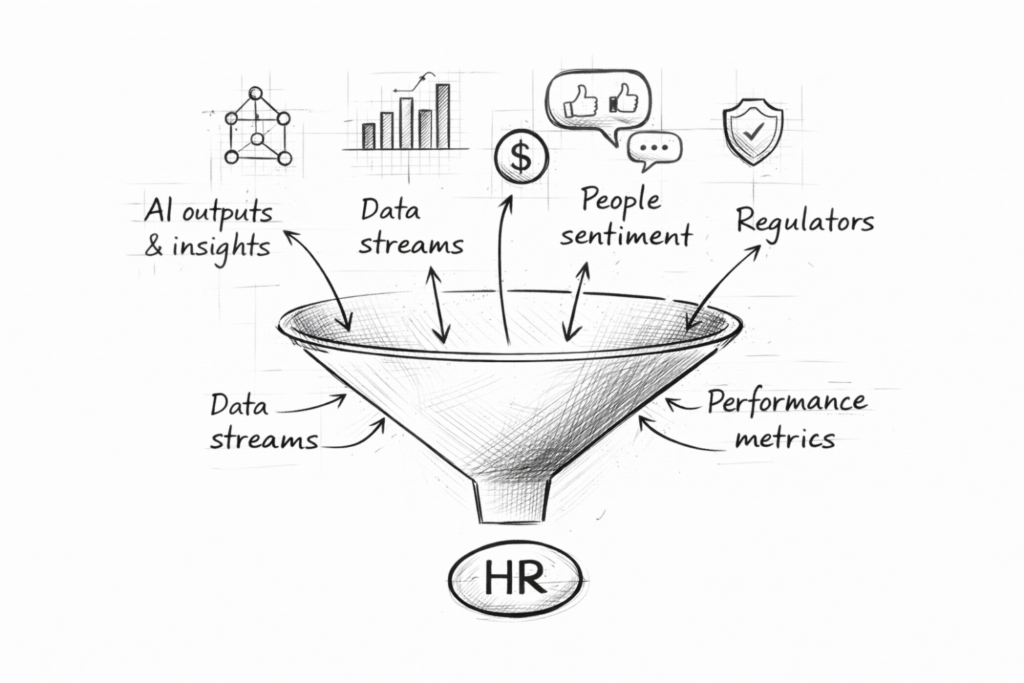
- AI decisions must be explained.
- Pay decisions must be justified.
- Processes must be traceable.
The European Union now classifies many HR-related AI uses as high-risk, requiring documentation, oversight, and explainability (https://artificialintelligenceact.eu/high-level-summary/ ).
The National Institute of Standards and Technology (NIST) makes it clear: managing AI risk is about evidence, not intention (https://www.nist.gov/itl/ai-risk-management-framework ).
Why this matters:
HR will be asked to explain decisions and not values. Those who cannot prove fairness will carry the risk.
5. No movement, no loyalty
People do not leave because work is hard. They leave because they feel stuck. Across countries, the tendency is the same:
- pressure is accepted if there is growth
- stability is rejected if there is none
The LinkedIn’s Economic Graph shows that internal mobility strongly improves retention, while skill stagnation drives exits (https://economicgraph.linkedin.com, https://economicgraph.linkedin.com/content/dam/me/economicgraph/en-us/PDF/apac-special-report-internalmobility.pdf ).
The OECD confirms that career mobility is now central to engagement and employability (https://www.oecd.org/en/publications/2025/07/oecd-employment-outlook-2025_5345f034.html ).
Why this matters:
I believe in 2026, engagement programs would not compensate for blocked careers. Movement will.
6. HR must prove its case
HR authority is changing. The leaders gaining influence are not the loudest. They bring:
- data
- scenarios
- trade-offs
- decisions
Work from Harvard Kennedy School and the The Wharton School shows that evidence-based people decisions build trust and reduce politics (https://www.researchgate.net/publication/364389487_People_Analytics_An_Evidence-Based_Approach_in_Managing_Employees ).
Why this matters:
HR will not be asked to inspire. It will be asked to decide and explain.
The end of safe HR
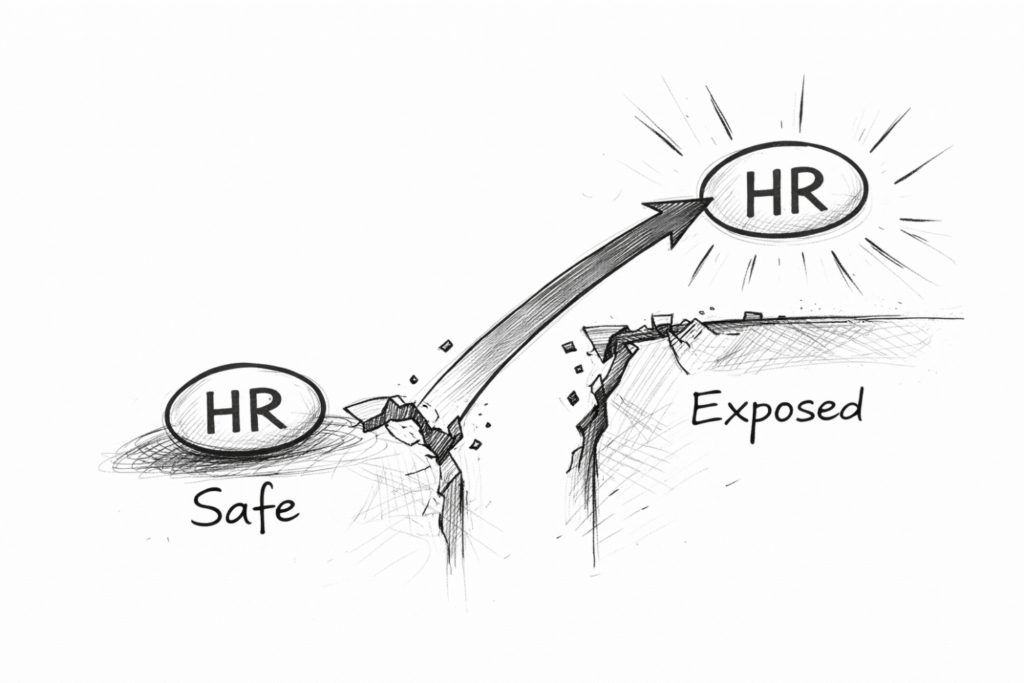
When decision pressure, visibility and accountability run over, there is no safe position left.
Safe HR meant:
- advice without ownership
- policies without consequences
- support without decisions
That model is ending. What replaces it is accountable HR, the one who designs systems, makes choices and stands behind them.
Uncomfortable? Yes.
Necessary? Absolutely.
This is not the end of HR.
It is the end of safe HR and the beginning of HR that truly matters.
My final thought
HR in 2026 will not become more human. And not more digital. It will become more accountable.
And honestly, that might be the best thing that could happen to our profession.
