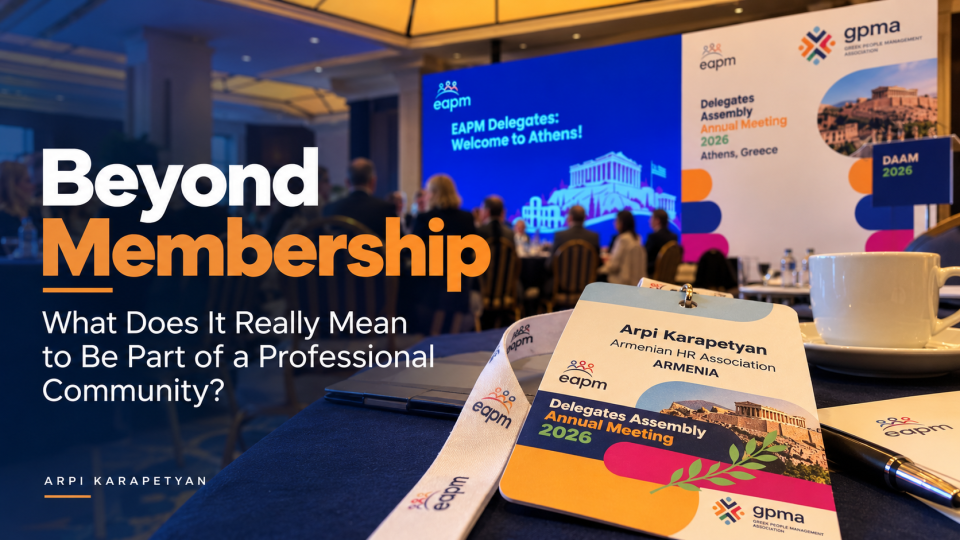
Reflections from the EAPM Delegates Assembly 2026 | Athens, Greece
On October 15, I attended the Annual Delegates Assembly of the European Association for People Management EAPM (EAPM) in Athens, representing the Armenian HR Association (www.hrcommunity.am).
I have participated in many international meetings over the years, but I always try to return home with more than information about what has been discussed or decided. I look for ideas worth questioning, approaches worth adopting and opportunities that could make a difference for our professional community.
This year’s Assembly gave me few things to think about.
And perhaps the most interesting was one simple question: Are we members of professional associations to benefit from what they offer, or to create something valuable together?

Membership Is Not a Menu
One of the ideas that resonated with me came from David Ducheyne , who introduced two approaches to membership during his presentation: menu-thinking and opportunity-seeking.
The first is familiar. We join an association, look at its services, events, publications, and benefits, and decide which ones are useful to us. The second approach is different. Instead of asking what the association can give us, we ask what becomes possible because we are part of it.
David’s point made me reflect on something I have been experiencing for years while developing the Armenian HR community.
Professional associations can easily become service providers in the eyes of their members. We organize conferences, offer training, facilitate networking, share knowledge and continuously work to demonstrate the value of membership.
But should that be the primary measure of our success?
A professional association is not a supermarket of benefits. Its real strength is in the collective capacity of its members to achieve what none of them could accomplish individually.This requires a change in mindset, not only among members but also among those of us leading associations.
We need to create more opportunities for contribution, joint projects, knowledge exchange and collective influence. And members need to see themselves as participants in developing the profession, rather than simply recipients of services.

From National Communities to Global Influence
Another idea that stayed with me was how professional associations connect across different levels.
EAPM brings together national HR associations from 34 countries, connecting professional communities across Europe and, through the World Federation of People Management Associations (WFPMA), with the wider global HR community.
What does this mean in practice?
It means that an idea developed in Armenia can contribute to a European discussion and potentially reach a global audience. Equally, research conducted internationally can become the basis for new initiatives, professional standards and conversations in Armenia.
But this does not happen automatically.
International membership creates access. Active participation turns that access into influence. For smaller countries, including Armenia, this distinction is especially important. We may not have the largest professional communities or the biggest budgets, but we have experience, perspectives and ideas that deserve to be part of international conversations.
Our responsibility is to make sure they are heard.
Research Is Valuable When We Actually Use It
The Assembly also presented the results of several international initiatives, including research conducted in cooperation with WFPMA, Boston Consulting Group (BCG), and the World Economic Forum (WEF) .
One particularly interesting project was Creating People Advantage, developed by WFPMA and BCG. The research gathered responses from 7,115 participants across 116 countries, with EAPM member associations contributing approximately one-third of the survey data. The findings highlight four priorities for the HR function of the future: delivering business value through HR, leading digital and AI transformation, building workforce and leadership capabilities and anchoring organizational change.
None of these priorities should surprise experienced HR professionals. What concerns me more is the distance that often exists between understanding these priorities and acting upon them. We have been discussing the strategic role of HR for decades. We have talked about becoming business partners, leading transformation and developing organizational capabilities. Yet in many organizations, HR is still expected to demonstrate why it deserves a place in strategic decision-making. Perhaps it is time to spend less energy explaining why HR matters and more energy demonstrating the business results it creates.
The same applies to international research.
A report with thousands of respondents is a valuable resource. But its real impact begins when professional communities interpret the findings, challenge their assumptions and translate them into practical changes.
I was pleased to see that EAPM is increasingly focusing on making research accessible and relevant at the national level. And for Armenia, I see considerable potential here.
International HR Day: A Project Close to My Heart
Of all the initiatives discussed at the Assembly, International HR Day holds a special place for me. I have been part of the International HR Day Working Group and seeing how this initiative has developed into a truly international movement gives me a particular sense of pride.
When you are involved in building something, you know how much work happens behind the scenes. The discussions, ideas, coordination between countries and countless small contributions that eventually turn into something much bigger.
The results presented in Athens were particularly encouraging. The 2026 Global Steps Challenge brought together more than 16,000 participants from 100 countries, who collectively walked 11.4 billion steps, exceeding our original target of 7 billion.
The HR Together video campaign also generated more than 53,000 LinkedIn impressions and 18,000 views. But beyond these numbers, what makes me happiest is seeing HR professionals from different parts of the world come together around a shared professional identity. We spend so much of our professional lives helping other people and organizations grow. International HR Day is an opportunity to celebrate the people behind that work.

For 2027, the proposed theme is:
“Lead change. Keep it human.”
I cannot think of a more relevant message for our profession today. With artificial intelligence, automation, and technological transformation dominating so many professional discussions, we should be careful not to lose sight of what makes our profession distinctive. Technology will continue to change how we work. But understanding people, organizations, relationships, and human behaviour remains at the centre of HR’s contribution. And I believe we need to become much better at explaining and demonstrating that contribution.
New Leadership, New Responsibilities
The Assembly also marked an important leadership transition for EAPM.
David Ducheyne from Belgium was elected President, while Kai Saard from Estonia was elected Vice-President. Ivan Papič from Slovenia and I were elected to the EAPM Board, and Unnur Ýr Konráðsdóttir from Iceland was elected Auditor.

The elections also marked the approaching conclusion of Berna Oztinaz ’s presidency.
And here I want to say a few special words about Berna. Some people impress you with their professional achievements. Others leave a lasting impression because of who they are as human beings. Berna is one of those rare people who do both. Her energy, warmth, generosity, and genuine care for people are exceptional. She has a remarkable ability to bring people together, make them feel valued, and inspire them to contribute. Behind her strong leadership is an extraordinary human being, and I feel truly fortunate to know her.
For me, being elected to the EAPM Board is both an honour and a responsibility.
It is an opportunity to bring Armenia’s experience and perspective into European discussions, but equally important, to bring European knowledge, connections, and opportunities closer to our HR community.
I look forward to working with my fellow Board members and the wider EAPM community.

What Should We Expect from Professional Associations?
The Assembly also made me reflect on the future of professional associations themselves.
We operate in a world where information is widely available, online learning is accessible and professional networking no longer requires formal membership in an organization.
So why should professionals and organizations continue investing their time and resources in associations?
I believe the answer lies in three areas discussed during the Assembly: content, collaboration and connection.
Content helps us learn and save time, collaboration allows us to undertake projects that would be difficult to accomplish alone. Connection gives us access to people, experiences and perspectives beyond our immediate environment.
But I would add a fourth dimension: Influence.
Professional associations should help shape the future of their professions. They should contribute to policy discussions, establish professional standards, generate credible research, support the development of future professionals, and represent the collective voice of their communities. And, this is particularly relevant for HR.
A Few Thoughts I Am Bringing Back to Armenia
After the Assembly, I found myself thinking about what all these discussions mean for our own HR community. Over the years, we have invested considerable effort in building professional connections, developing learning opportunities, organizing conferences, and bringing international expertise to Armenia.
These activities remain important.
But I more and more believe that the next stage of development for our professional community should be measured not only by how many activities we organize or how many professionals participate, but by what changes because of our work.
Are we helping organizations make better people-management decisions? Are we contributing to the development of stronger HR professionals? Are we influencing how businesses understand the value of human capital? Are we creating opportunities for Armenian professionals to contribute internationally, rather than only learn from international experience?
And the last, but not the least important question- Are we developing a community capable of taking collective responsibility for the future of our profession?

These are questions I intend to keep asking, including in my new role on the EAPM Board.

I returned from Athens with new responsibilities, interesting ideas and a stronger conviction that professional communities have much greater potential than we sometimes allow ourselves to imagine.
Membership gives us a place in a professional community. What we choose to do with that place determines its value.
And that, for me, is where the real work begins….