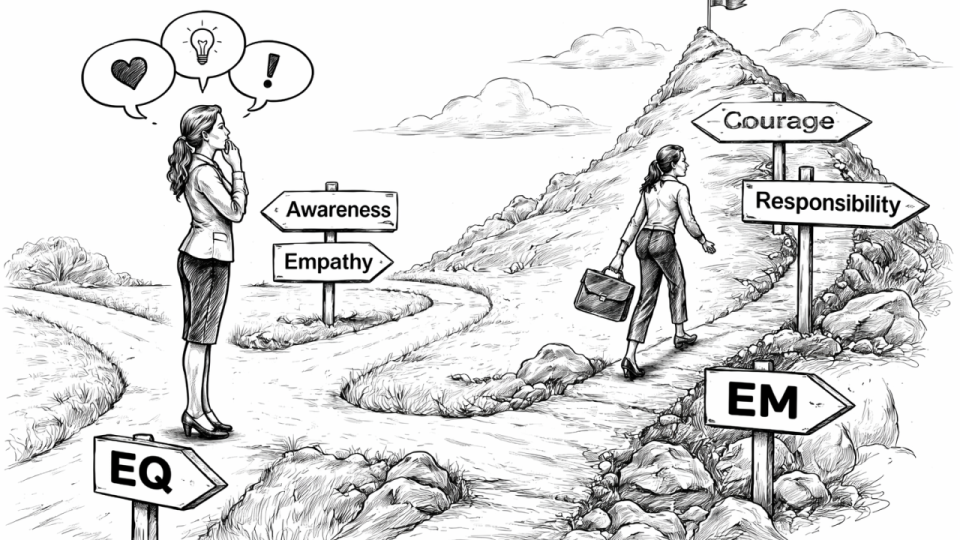
EQ is not enough. I propose we start talking about EM
If you look at leadership development today, one trend is impossible to miss.
Emotional Intelligence has become one of the most demanded topics in leadership development. It is taught in trainings, included in competency models and treated almost as a universal answer to difficult people problems, team tension and leadership communication. Daniel Goleman’s work played a major role in making that conversation mainstream, especially by positioning self-awareness, self-regulation, empathy and social skill as central to effective leadership. That contribution was important and really matters. Research reviews also show that emotional intelligence remains strongly connected to leadership and team functioning.
But after years of working with leaders, I keep seeing the same limitation.
A leader may be highly emotionally intelligent and still avoid the real issue. He may read the room well, notice feelings, regulate their tone, choose careful words ….and yet postpone the necessary decision, soften the truth beyond usefulness or protect himself instead of protecting the system. In other words, awareness may be present, but leadership capacity is still insufficient.
EQ and EM
This is exactly why I propose using Emotional Maturity (EM) as a more precise leadership lens than EQ alone.
I am not using EM here as a decorative synonym for better emotional skills. I am using it as a different category. For me, emotional maturity is the capacity to remain in contact with reality, carry the emotional cost of that reality and still act consciously rather than defensively. That is a different angle. It is one thing to understand emotions and regulate them. It is another thing to withstand what that understanding demands from you.
That distinction becomes clearer if we move beyond emotional intelligence theory and bring in adult development. Robert Kegan’s work is especially useful here. His constructive-developmental approach argues that adults do not simply accumulate skills, they can also transform the very structure through which they make meaning. His subject-object perspective is critical. What I am “subject to” controls me. What I can make “object” I can examine, question and regulate.

This is where my argument begins
Many leaders today have enough emotional vocabulary to describe what they feel. Far fewer can step outside the internal structure that is producing their reaction. They can name their frustration, but they are still run by it. They can identify fear, but they still design decisions around avoiding loss of image, authority, control, or belonging. In practice, this means EQ often improves perception, but not necessarily developmental freedom.
And leadership, especially serious leadership, is not tested in calm moments. It is tested in moments where something must be risked.

That is why I also find Bill Torbert’s action logics crucial. His model shows that leaders do not differ only by skill level, they differ by the logic through which they interpret action, power, success, conflict and change. Some logics protect order, some optimize results, some are capable of reframing the whole system. His work suggests that leadership effectiveness is tied not only to competence, but to the developmental sophistication from which action is taken.
This matters enormously for how we understand emotion in leadership
Because the same emotional event can produce very different leadership behavior depending on the developmental logic behind it.
Take one difficult conversation. One leader experiences anxiety and turns controlling. Another experiences anxiety and delays. A third experiences anxiety and still proceeds, because the discomfort is no longer the final authority in the room. That, to me, is not simply a difference in emotional regulation technique. It is a difference in maturity.
And then there is the part that organizations often prefer not to examine too closely: defense.
In practice, what is often called leadership style is sometimes a socially acceptable defense mechanism with a polished vocabulary. Rationalization may appear as strategic patience, avoidance may appear as diplomacy, overcontrol may appear as high standards, intellectualization may appear as analytical depth. Anna Freud wrote about defense mechanisms that remains very relevant if we want to understand why very capable leaders still distort reality under pressure.
This is one of the central reasons I believe EM deserves separate attention.
A leader can have enough EQ to notice tension in the team and still lack the maturity to ask: What exactly am I defending right now? My role? My image? My certainty? My innocence? My right to be liked?
That is not a soft question. It is a structural one.
This is also why I do not define emotional maturity as calmness, kindness or composure. Some of the most immature leaders can look very composed. They are just defended elegantly. For me, emotional maturity is better recognized through a different set of indicators:
Can the leader stay in contact with contradiction without rushing to simplify it? Can they tolerate guilt, ambiguity and incomplete control without collapsing into defense? Can they distinguish between protecting people and protecting their own self-image? Can they act without first arranging the situation so they feel psychologically safe?
That is a much tougher standard than can they read emotions?
There is another paradox here. Emotional maturity does not make leadership emotionally easier. In many cases it makes it heavier. As leaders become more developmentally complex, they tend to see more perspectives, more unintended consequences, more systemic costs. Kegan’s work on adult transformation and Torbert’s work on later action logics both point in that direction: growth does not remove complexity, it increases one’s capacity to hold it.
EM should not be sold as a comfort model
It is not about feeling better. It is about becoming more capable of carrying what leadership actually is.
That is why, in my own work, I increasingly treat EQ as necessary, but EM as decisive.
- EQ helps a leader perceive. EM determines whether that perception can be turned into responsible action.
- EQ helps a leader recognize emotional signals. EM determines whether they can stay with those signals long enough to learn from them rather than defend against them.
- EQ helps a leader communicate with sensitivity. EM determines whether they can tell the truth without hiding behind sensitivity.

This is the shift I want to bring into the conversation.
Not because emotional intelligence is wrong. It is not. It remains deeply useful and well established. But in leadership development it is often treated as if awareness itself were enough. My experience says otherwise. The real gap is usually not in naming emotions. It is in bearing the emotional and identity cost of mature action.
So when I use the term Emotional Maturity (EM), I mean a developmental leadership capacity that integrates four things:
- first, emotional awareness;
- second, the ability to make one’s own reactions and defenses observable to oneself;
- third, the ability to hold complexity and tension without premature simplification; fourth, the willingness to act consciously even when the action threatens comfort, image, or certainty.
That, to me, is one level beyond EQ. And frankly, that is the level leadership requires.
Because organizations are not suffering only from leaders who cannot understand emotion. They are also suffering from leaders who understand a lot, speak beautifully, and still do not cross the inner threshold from awareness to responsibility.
That level is where my interest is.
That level is where I believe the next conversation in leadership development should move. And that level is exactly why I propose we stop treating emotional intelligence as the destination.
It is the entry point.
The term I propose – Emotional Maturity is the harder, more honest and more leadership-relevant question.
I would be genuinely curious to hear your perspective.