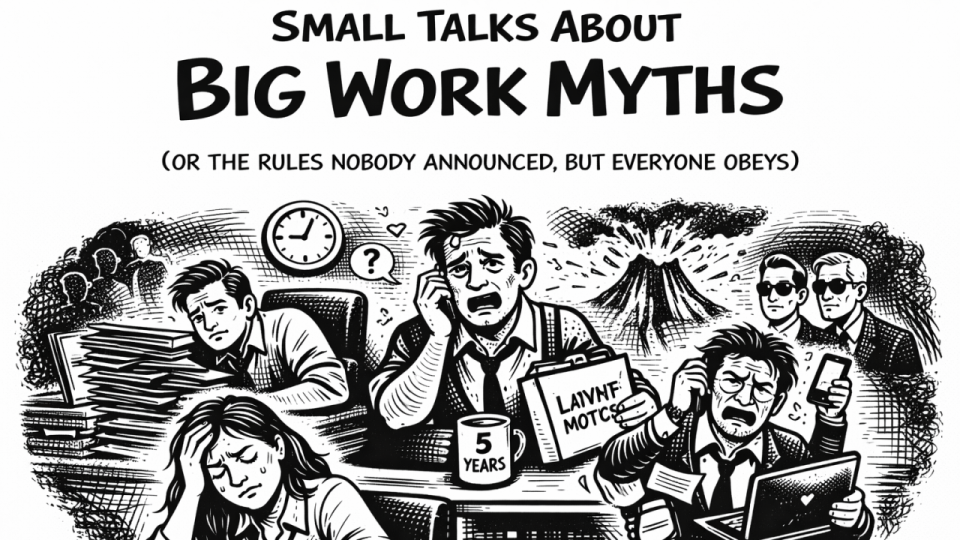
Small Talks About Big Work Myths
(or the rules nobody announced, but everyone obeys)
There is a point in many careers where people stop asking whether something makes sense and start asking whether it is normal.
Is it normal that I am always tired.
Is it normal that nothing changes even though I do more.
Is it normal that this feels off, but everyone else seems fine.
That is usually when myths stop being motivational and start being dangerous. Because they explain discomfort instead of questioning it.
Myth 1. Work hard and you will be appreciated
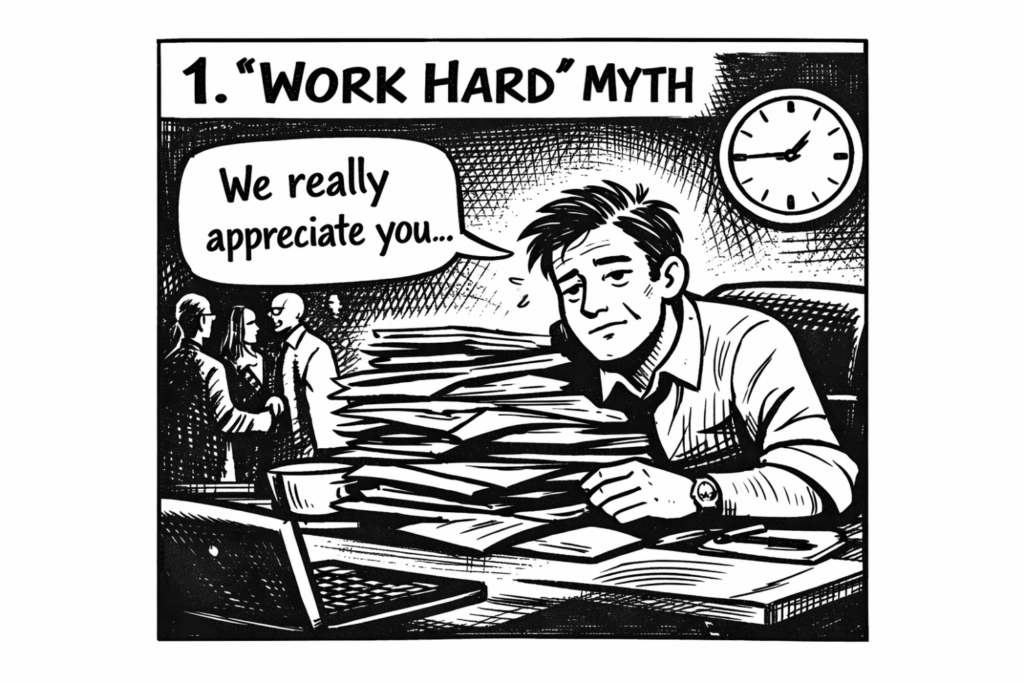
Just focus on doing great work. They will notice.
They do notice. They just notice your capacity, not your direction.
Hard work sends a very clear signal. It says you can handle more. It says you will adapt. It says you are unlikely to push back. What it does not say is that you should be repositioned, promoted, or listened to differently.
Over time, people who work hard without reframing their role slowly disappear behind their output. They become associated with tasks instead of thinking, execution instead of influence. And when they finally ask for recognition, the system is already used to them exactly where they are.
The uncomfortable truth is this. Effort earns trust. And only positioning earns change.
Myth 2. Long hours mean high productivity
I stayed until eleven last night.

That statement carries pride. It should carry concern.
Long hours usually appear where decisions are postponed, priorities are unclear, or responsibility is blurred. Someone stays late not because the work is meaningful, but because no one upstream was willing to decide what actually mattered.
Productivity is not a moral quality. It is structural. It depends on clarity, sequencing, and limits. When those are missing, hours expand to fill the confusion.
Staying late often feels responsible. In reality, it quietly trains the system to continue being inefficient. The cost is paid slowly. In attention. In energy. In resentment.
Myth 3. If someone is always busy, they must be very important
She is always in meetings. He is booked weeks ahead.

Busy has become a status symbol.
But real importance rarely looks chaotic. People who shape outcomes usually have something others do not. Time to think. Time to prepare. Time to decide without panic.
Constant busyness is often a sign that someone is reacting instead of leading. Their calendar is full because everyone else’s priorities land on them unchecked. From the outside, it looks impressive. From the inside, it feels like permanent catch-up.
Importance is not how many things depend on you.
It is how much space you have to decide what should exist at all.
Myth 4. Loyalty will be rewarded
I stayed when others left. I gave more than was asked. I waited.

That should count for something.
It does count. Just not in the way people expect.
Loyalty is emotional. Organizations are operational. They may appreciate commitment, but they do not build decisions around gratitude. They build them around relevance, timing, and future need.
The real damage happens when loyalty replaces conversation. When roles are not renegotiated. When value is assumed to be obvious. When expectations remain unspoken for years.
Then one day reality changes. A new leader. A new strategy. A new structure. And suddenly loyalty feels invisible, not because it was meaningless, but because it was never translated into something concrete.
Loyalty without clarity does not protect you.
It delays a necessary reckoning.
Myth 5. Good teams do not have conflicts
We never argue. Everything is smooth.

Smooth is rarely healthy.
Conflict is not a breakdown of trust. It is often evidence of it. Teams that trust each other enough to disagree early save themselves from much heavier costs later.
Teams that avoid conflict usually do so for a reason. Fear of being labeled difficult. Fear of disturbing harmony. Fear of consequences. The price is paid quietly. In disengagement. In sarcasm. In decisions no one truly supports.
A team without conflict is not aligned. It is careful.
Myth 6. If you love your job, you will never get tired
Maybe I am tired because this is not my path anymore.

Or maybe I am tired because I care deeply and give a lot.
Meaningful work demands more than competence. It demands attention, emotional presence, and responsibility. The idea that love for work should feel light is misleading. Depth is heavy by nature.
Burnout is often misunderstood as loss of interest. In reality, it is frequently the result of prolonged over-involvement without enough recovery or control. Loving your work does not exempt you from limits. It makes limits more necessary.
Fatigue is not always a sign to leave. Sometimes it is a sign to renegotiate how you stay.
Myth 7. More training will fix the problem
Let us send them to another course.

Because knowledge is rarely the issue.
Training is comfortable. It creates activity without confrontation. It allows organizations to feel proactive without touching power, structure, or accountability.
Most people already know more than they are allowed to use. The gap is not skill. It is permission, clarity, and ownership. Without addressing those, training becomes a polite way to postpone uncomfortable change.
Development does not fail because people do not learn. It fails because the system stays the same.
No wrap-up. Just a pause.
Work myths survive because they sound reasonable and ask very little at first. They become expensive only over time.
The real shift happens when you stop asking whether something is normal and start asking what it is costing you.
Which of these myths have you outgrown, but still occasionally catch yourself obeying.
That question is usually where the real work begins.
