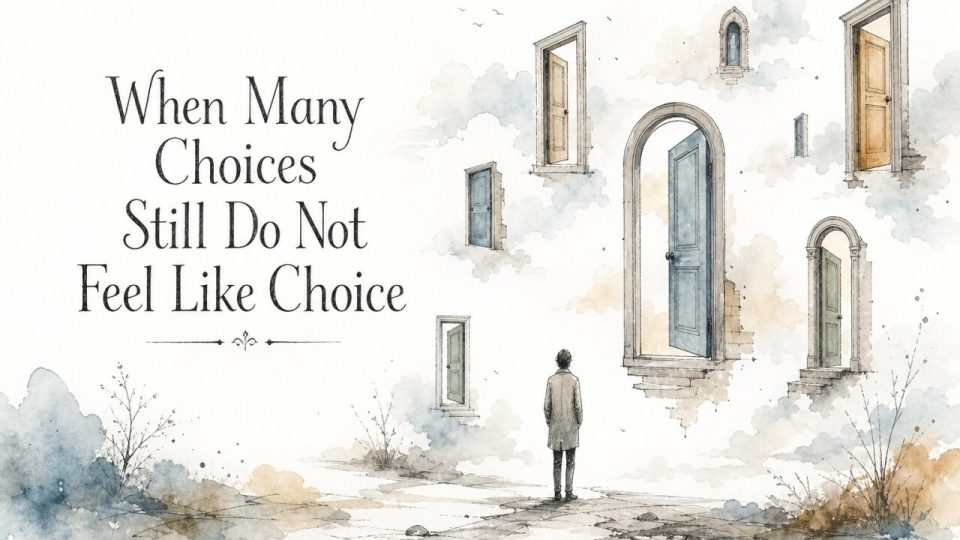
When Many Choices Still Do Not Feel Like Choice
I have been thinking about one big thing today. We often believe that the more options we have, the freer we are.
More options. More voices. More directions. More possible answers. It sounds right.
But in real life, especially in emotionally important moments, it does not always work like that.
Sometimes many choices do not create clarity.
They create noise. And, sometimes they do not make us stronger. They split our energy. Sometimes they give us the feeling that we are choosing, while deep inside we still feel that there is no real choice.
And this is not only a social phenomenon. This is human psychology.
One explanation is choice overload. Research by Sheena Iyengar and Mark Lepper showed that people may be attracted to more options, but too many options can reduce motivation and make the final choice harder. The brain starts comparing, excluding, doubting, imagining possible losses and carrying the emotional weight of responsibility. When the decision is small, variety is pleasant. Having options feels exciting while choosing a coffee, a movie, a restaurant, a dress or a travel destination.

But the mind works differently when the decision touches our future, our values, our disappointment, our trust, our fears and our hope.
We do not only ask: What do I like?
We start asking deeper questions:
Can I trust this? Will this really change anything? What happens if I make the wrong choice? Am I choosing something new, or am I only reacting to something old? Is this a direction or just another option?
This is where too much choice becomes heavy. Herbert Simon called another part of this bounded rationality. Human beings do not make decisions with unlimited information, unlimited time and unlimited emotional clarity. We simplify. We search for something that feels “good enough”. We reduce complexity because the mind cannot process everything at once. Simon challenged the idea of the perfectly rational decision-maker and showed that people often “satisfice” rather than optimize. And when there are too many unclear options, people often do not choose the best one. They choose the one that reduces pressure.
- Sometimes this is the most familiar option.
- Sometimes it is the safest-looking option.
- Sometimes it is the option others seem to be choosing.
- Sometimes it is no choice at all.
This connects to status quo bias, our tendency to stay with what already exists. Samuelson and Zeckhauser’s research showed that people often keep the current or previous decision, especially when “doing nothing” is also an available option.
And, let us state, that under pressure, people do not always imagine or think rationally
Very often, they protect themselves. This is also close to loss aversion, one of the key ideas in prospect theory by Daniel Kahneman and Amos Tversky. People often feel the pain of possible loss more strongly than the pleasure of possible gain. So when the future is unclear, the mind may prefer a known discomfort over an unknown risk.

This does not mean people are happy with the current situation. People may criticize it. They may be tired of it. They may even want something different. But wanting change and choosing change are not the same thing. This is one of the most painful truths of transformation. People may want change and still not move toward it if the alternative does not feel strong enough, safe enough, clear enough or real enough.
The old system survives
Not because it is loved or is good. Not even because people truly choose it. But because it is more organized than the alternative.
Here another theory becomes important: social identity theory. People do not choose only as individuals. They choose as members of groups. They look at “us” and “them”. They look for belonging, safety, recognition and shared meaning. When there is no clear collective “we”, people return to smaller identities: family, team, department, community, personal interest, personal disappointment. So instead of one direction, we get many separate emotional logics.
Everyone may want movement. But not everyone imagines the same destination. In group behavior, fragmented energy rarely becomes movement by itself.
- Many small dissatisfactions do not automatically create one strong direction.
- Many voices do not automatically become one shared vision.
- Many options do not automatically become freedom.
This is why I keep returning to one thought:
The opposite of something is not yet an alternative to it
Being against something is not the same as knowing what we are for.
- Dissatisfaction is not a strategy.
- Criticism is not a vision.
- Anger is not a roadmap.
- Many small directions are not always movement.
There is also cognitive dissonance here. When people feel tension between what they want, what they believe and what they are actually able to choose, the mind tries to reduce discomfort.
- Sometimes it does this by choosing what is familiar.
- Sometimes by justifying inaction.
- Sometimes by saying –Nothing will change anyway.
- Sometimes by waiting for others to create clarity first.
And this can slowly move into learned helplessness. When people repeatedly feel that their actions do not change the outcome, they may stop acting with full energy. Not because they do not care, but because somewhere inside they no longer fully believe that their choice can influence the result. Later research on learned helplessness has emphasized this subjective experience of lack of control.
That is a dangerous moment for any society, organization, team or individual
Because the person still has options. But internally, the person does not feel real agency. And maybe this is the key difference. Freedom of choice is not only about the number of options available. It is also about whether people feel that their choice has meaning, direction and impact.

This is why real choice needs clarity. It does not mean everything should be black and white. Life is never that simple. But psychologically, people need to understand not only what they are leaving behind, but also what they are moving toward. Without a clear “toward”, people often return to what they already know. Even if they are tired. Even if they complain. Even if they want something different.
Because uncertainty is expensive for the human brain. And if the alternative is not strong enough, clear enough and emotionally believable enough, the familiar wins.
This is true in leadership. It is true in organizations. It is true in communities. And it is true in personal life.
We often think the main problem is lack of options. But sometimes the real problem is lack of a clear alternative.
Sometimes the deeper question is not: How many choices do we have?
The real question is: Do these choices help us move somewhere?
Freedom of choice is powerful. But it needs maturity, responsibility, trust and agency. Because too many doors do not always create freedom.
And maybe choice becomes real only when it gives us direction.